

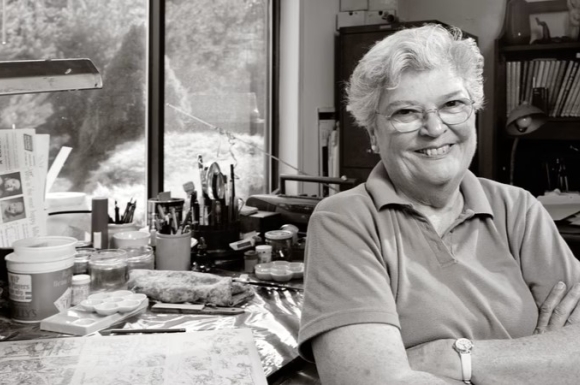
Biography
Marie Severin was born on August 21, 1929, in East Rockaway, NY, but grew up on both Long Island and in Brooklyn. She was the second child of John and Marguerite—both of whom were active artists and encouraged her and her brother’s artistic abilities. Growing up, she attended a Catholic elementary school, followed by an all-girls high school before enrolling at Pratt Institute. However, after a day, Marie decided she didn’t want to spend four years at an art school—instead wishing to jump straight into a career to earn money. Prior to kicking off her comic career, she worked as a clerk with an insurance company for several years on Wall Street. While working in New York, her brother approached her with an offer to work alongside him at EC Comics—an offer which she readily accepted.
Working at EC, Marie became an integral part of the company and its primary colorist. Her first coloring job was done for A Moon, A Girl, Romance #9 (1949). As described by Al Feldstein, Marie was the “Catholic Conscience” or moral compass of the team. Many have said that she would often fill pages with one color to tone down the gore or profanity. However, in a Comics Journal interview—originally published in The Comics Journal Library Volume 10: The EC Artists, Part 2 (2016)—she stated not only did the one color clarify the details of the inking, but it was in part due because she didn’t want the crew to get in trouble or get arrested.[1] On another note, this was a valid concern considering EC—along with other comics publishers—was brought before the United States Senate Subcommittee on Juvenile Delinquency in 1954 regarding the impact crime and horror comics had on young readers. The trial eventually led to the Comics Code Authority, a self-imposed code adopted by the comics industry following the unfavorable press coverage resulting from the hearings. Because of this, EC discontinued many of its titles, leaving artists without work. At this time, MAD was the only big title left standing at the EC offices.
Until that time, Marie worked as a colorist for almost all of its titles. After the hearings, she was left working on MAD. However, in an effort to get around the Comics Code Authority, MAD switched the black-and-white magazine format—leaving Marie with nothing to do. With her work all but done at EC, she followed her brother to Atlas Comics. Atlas Comics—now known as Marvel Comics—was run by editor-in-chief, Stan Lee. For a couple of years, Marie worked at Atlas, where she continued her work coloring for various titles. However, in 1957, American News Company—the newsstand distributor that circulated Atlas comics—lost a Justice Department lawsuit, eventually ceasing operations. With no other options, the publisher of Atlas Comics, Martin Goodman, had no choice but to turn to the distributor Independent News—owned by National Periodical Publications. National Periodical Publications—now known as DC Comics—was not only Atlas’ comics rival, but their strict publishing parameters only allowed them to print eight titles per month. Because of these new regulations and costly financial mishaps, the company laid off almost all of its artists and started publishing unused stories from its inventory. Following the mass firing, Marie turned to work for the Federal Reserve Bank of New York, where she created educational and promotional art and comics before working for a filmstrip production company.
It wasn’t until 1961 that Atlas Comics soon became Marvel Comics; and it wasn’t until 1964 that Marie would return to the company as a production artist. Her career at Marvel spanned three decades—with some of her most notable work appearing in its various titles and publications. Starting off as a colorist, she worked on many titles—eventually elevating herself to production artist. In the September 1966 college issue of Esquire, her work appeared alongside that of Jack Kirby’s in an article regarding the impact comics have on college campuses. Her work caught the attention of Stan Lee, who—in the same year—assigned her to take over the Dr. Strange feature in Strange Tales from Bill Everett. She worked on the feature as co-writer—alongside Stan Lee—penciler, inker, and colorist from issue 153 through 160. It was during this time that she co-created the entity known as the Living Tribunal, which debuted in Strange Tales #157. In the following years, Marie worked on numerous titles that have become synonymous with Marvel. These include The Incredible Hulk, Sub-Mariner, Daredevil, and Kull the Conqueror—the latter of which she worked alongside her brother. Besides superhero stories, she was also a big contributor to the humor magazine Crazy and its comic Not Brand Echh—Marvel’s response to EC’s success with MAD, which parodied its own characters.
Through the 70s, Marie acted as the head colorist at Marvel—until 1972 when she handed the reins over to George Roussos to focus more on her penciling, inking, and lettering. In 1976, as a production artist, she had a hand in designing Spider-Woman’s original costume, which debuted in Marvel Spotlight #32. Working through to the 90s, she had a hand in various projects—including illustrations for toys and Marvel’s short-lived children’s books. Post-Marvel, she continued her penciling and inking for various comic titles; including Soulsearchers and Company #31 (1998). She also worked for DC Comics, Marvel’s competitor, contributing to Pinky and the Brain #27, Supergirl Plus #1, and nearly every issue of Superman Adventures from 1996 to 2002.
In 2004, she revisited EC, modifying the colors in some issues for a Fantagraphics compilation of Bernard Krigstein’s comics published that year. In 2001, she was inducted into the Will Eisner Hall of Fame. Later in life, she became a freelance artist and a frequent guest at comic conventions—in 2017, Comic-Con International presented her with its Icon Award.
On August 30, 2018, Marie passed away following a stroke at 89—she was the last surviving member of the original EC crew.
[1] Dean, Michael. “Marie Severin: 1929-2018.” The Comics Journal. Accessed 24 September 2025. https://www.tcj.com/marie-severin-1929-2018/
Illustrations by Marie Severin
Additional Resources
Bibliography
Cassell, Dewey and Aaron Sultan. Marie Severin: The Mirthful Mistress of Comics. Raleigh: TwoMorrows Publishing, 2012.
Cavna, Michael. "Hall of Fame artist Marie Severin, 89, was a beloved and irrepressible comics pioneer." Washington Post, 31 Aug. 2018.
Laity, K.A. "Review of Women in Science Fiction and Fantasy." Femspec, vol. 10, no. 2, July 2009, pp. 135+.
Rosenberg, Meisha. "Women and cartoons: for half of America, the golden age of comics isn't a matter of history--it's a work in progress." Print, vol. 60, no. 5, Sept.-Oct. 2006, pp. 176+.


_60_60_c1.jpg)


_60_60_c1.jpg)


_60_60_c1.jpg)


