

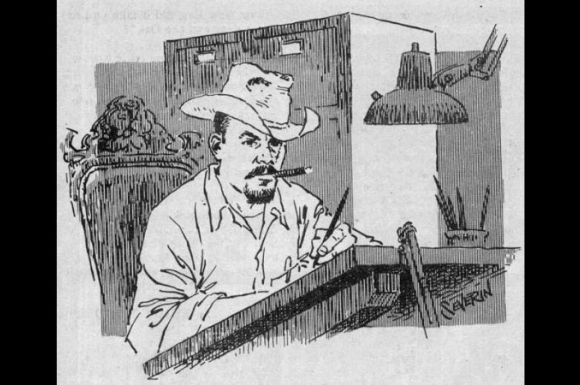
Biography
John Severin, an American comic artist, was known for his draftsmanship, historical accuracy, and genre flexibility—from war and Westerns to humor and satire. In a career spanning over six decades, Severin left an indelible mark on the comics industry, producing thousands of pages for publishers like EC, Marvel, DC, Warren, and Cracked. Known for his realism and meticulous research, peers and editors alike celebrated him as one of the most dependable and skilled illustrators in the medium.
Born in Jersey City, New Jersey—just two years after the stock market crash—Severin moved with his family to Bay Ridge, Brooklyn, when he was an infant, and later to Long Island. His father, an accountant who also dabbled in commercial illustration, and his mother, a homemaker and designer, were supportive of John’s early passion for drawing. He began sketching at age two, and his parents encouraged him to pursue his interests freely.
As a child, Severin was more enamored with Sunday newspaper strips than comic books—he loved pulp magazines and admired comic strips like Buck Rogers, Flash Gordon, and Terry and the Pirates. Artistic influences included Roy Crane and Hal Foster, while later he admired artists like Jack Davis, Joe Kubert, and Western painter Charles Marion Russell.
Severin’s first published work came at the young age of 11 or 12, when he sold gag cartoons to The Hobo News, a low-cost paper sold by and for the homeless. He received a dollar per cartoon, which was significant for a teenager during the Depression era.
He attended St. John’s Prep School in Brooklyn before transferring to the High School of Music and Art in New York City, where he met future comics luminaries Harvey Kurtzman, Will Elder, Al Jaffee, and Al Feldstein. His studies, however, were interrupted by World War II.
Severin enlisted in the U.S. Army in 1942, serving in the Pacific Theater. Though colorblind, he was able to spot camouflage better than others and was initially assigned to a camouflage unit. Later, he became a machine gunner and radio operator, though he did not see significant combat. After returning in 1946, he briefly attended art school on the G.I. Bill and began doing product illustration.
In 1947, Severin broke into comics through Crestwood Publishing, working on a Simon and Kirby story—later inked by Will Elder. He soon became a prolific contributor to Prize Comics Western, notably creating the American Eagle strip—remarkable for its respectful portrayal of an Indigenous protagonist. His detailed work on period pieces made him stand out in the Western genre.
Throughout the late 1940s and early ’50s, Severin frequently collaborated with Elder and his high school friend Colin Dawkins, while sharing studio space with Kurtzman. In 1950, he joined EC Comics, becoming a key contributor to Two-Fisted Tales and Frontline Combat under Kurtzman’s meticulous editorial vision. Severin’s work from this period, often co-inked with Elder, is still celebrated for its movement, drama, and historical authenticity.
He turned down horror stories and a lucrative offer from Playboy on moral grounds, preferring grounded, character-driven narratives. Severin began his work with EC in 1950, working on titles such as Two-Fisted Tales, Weird Fantasy and Frontline Combat. He and Elder often shared drawing and inking duties, and people frequently praised his precision in detail, motion, and character work. Severin was also one of the original artists who debuted in MAD in 1952. By 1953, Kurtzman had become preoccupied with work for MAD, thus editorship for Two-Fisted Tales was handed over to Severin. Becoming editor meant he would need to leave his work at the humor magazine, which was not a problem for him. However, after the discontinuation of most of EC’s publications—except MAD—and Kurtzman’s departure from the magazine, Severin had the opportunity to return. However, he had already begun a fruitful relationship with Stan Lee’s Atlas Comics—later Marvel—illustrating titles like Kid Colt, Rawhide Kid, and Sgt. Fury and His Howling Commandos.
In the late 1950s, Severin began a decades-long association with Cracked magazine. As the magazine’s primary cover artist and key contributor, he became their go-to film and television parodist. He also created the magazine’s mascot, Sylvester P. Smythe, and contributed under various pseudonyms to give the publication an appearance of artistic diversity. Severin remained with Cracked until its demise in 2007.
While often labeled a “war comics artist,” Severin’s talent transcended genre. He could deliver action-packed war sagas, authentic Westerns, and hilariously exaggerated caricatures with equal skill. His work appeared in Classics Illustrated, Creepy, Eerie, Blazing Combat, Savage Tales, and many Marvel titles including The Incredible Hulk, Conan the Barbarian, and Kull. He often worked as an inker—enhancing the pencils of giants like Jack Kirby, Gil Kane, Dick Ayers, and Herb Trimpe. Later in life, he even collaborated with his sister Marie Severin, herself a renowned comics artist and colorist.
From the 1960s through the 1980s, Severin was everywhere—contributing simultaneously to Cracked, Marvel, DC, and Warren Publications. His art graced titles such as Suicide Squad, Bat Lash, American Century, and Hellboy, continuing into the 21st century.
Despite his colorblindness, Severin had an unmatched eye for detail. He meticulously researched weaponry, uniforms, settings, and even facial expressions. His historical accuracy, dramatic composition, and expressive characters earned praise from industry greats—Jack Kirby once called him “the best war comics artist ever.” His solid inking style could elevate even the simplest pencils, and he was praised for his consistency and professionalism.
Although never a mainstream “fan favorite,” Severin was deeply respected by his peers and editors. His accolades include: the Inkpot Award (1998); Alley Awards for Sgt. Fury and His Howling Commandos (1967, 1968); Shazam Award nomination for Best Inker (1973); Spanky Award from the Cartoon Art Museum (2001); and his induction into the Will Eisner Comics Hall of Fame (2003). His art was exhibited multiple times at the Words & Pictures Museum in Northampton, Massachusetts.
Severin was a consummate professional—respected for his integrity, dedication, and boundless versatility. Though he never sought the limelight, his influence on war comics, Westerns, and satire remains immeasurable. His work, always rooted in realism, discipline, and storytelling, continues to stand as a benchmark for what comic art can achieve. He continued producing high-quality artwork into his 80s and 90s, working on titles for Marvel, Dark Horse, and others well into the early 2010s. He passed away in 2012 at the age of 90—leaving behind a vast legacy and an enduring influence on generations of comic artists.
Illustrations by John Severin
Additional Resources
Bibliography
Geissman, Grant et al. The Vault of Horror, Volume 2, Issues 18-23. Milwaukie: Dark Horse Books, 2022.
Goulart, Ron. The Great Comic Book Artists. New York: St. Martin’s Press, 1986.
Severin, John. The John Severin Westerns featuring American Eagle. Seattle: Fantagraphics Underground, 2023.
Severin, John, Mort Todd, and Mark Arnold. The Comedy of John Severin. Portland: Fun Ideas Productions & Comicfix, 2023.


_60_60_c1.jpg)


_60_60_c1.jpg)


_60_60_c1.jpg)


